Overwintering Citrus: How to Keep Your Lemon and Orange Trees From Freezing
Every year it’s the same story: as soon as the thermometer drops, your lemon, orange, or mandarin trees start sulking. Leaves turn yellow, stems brown, and those promising visions of fragrant fruit vanish under the bite of winter. The good news? There are plenty of ways to keep this horticultural tragedy from happening.
In this guide, we’ll cover your citrus trees’ real needs in winter, the prep work to do ahead of time, different overwintering solutions depending on your space (garden, balcony, terrace, conservatory, garage…), and the common mistakes to avoid. The goal: help your citrus survive the cold without shivering—so they’ll be ready to reward you with blossoms and fruit once spring returns.
Understanding Citrus Sensitivity to Cold
Why Citrus Are Naturally Frost-Sensitive
Citrus trees come from subtropical and Mediterranean regions. They’re built for warmth, high light levels, and mild winters. Their sap-rich tissues freeze easily once temperatures dip too low. Unlike apple or pear trees that shut down completely, citrus trees never really stop: they keep breathing, transpiring, and producing even at rest. That’s what makes them so vulnerable.
Cold Tolerance Thresholds
Not all citrus handle the cold equally:
- Kumquat, Citrus ichangensis, Poncirus trifoliata → hardy down to –10 °C (the toughest).
- Meyer lemon, some mandarins → tolerate –5 to –6 °C.
- Sweet orange, grapefruit → around –3 to –4 °C at best.
- Calamondin, citron, lime → freeze at –2 °C.
In short, while a lemon tree might weather a light frost, hardiness depends hugely on the variety. Knowing exactly what you’ve planted is half the battle.
Warning Signs of Cold Stress
Your citrus will send distress signals before the harvest is lost:
- Leaves curling or turning translucent → early signs of tissue freezing.
- Brown spots on foliage → frost burns.
- Sudden leaf drop → major stress.
- Blackened twigs → internal tissues have frozen.
The sooner you act, the better your chances of saving the tree.
Preparing Citrus for Winter
Overwintering isn’t just about “throwing on a frost cloth when it gets cold.” It’s prep work that begins in autumn.
Choosing the Best Spot
A smart location can give you 2–3 degrees of natural protection:
- Against a south-facing wall → it stores heat by day and releases it at night.
- Sheltered from wind → windchill makes cold bite harder.
- Avoid low spots → cold air pools at ground level. Raise pots if needed.
Clean, Prune, and Pest-Check
Before winter:
- Remove dead or diseased branches so the tree focuses energy on healthy growth.
- Dust off foliage if the tree will spend winter indoors—better respiration.
- Treat preventively for scale and aphids, which love citrus when they’re weakened.
A healthy tree always stands up to cold better.
Adjust Watering and Feeding
- Watering: taper off in autumn. In winter, too much water + cold = root suffocation.
- Fertilizer: stop completely by September. You don’t want fragile new growth right before frost.
Smart Overwintering Techniques
In the Ground: Rely on Passive Protection
If your citrus are planted outdoors in mild regions (Atlantic coast, French Riviera, Brittany…), outdoor overwintering is usually enough:
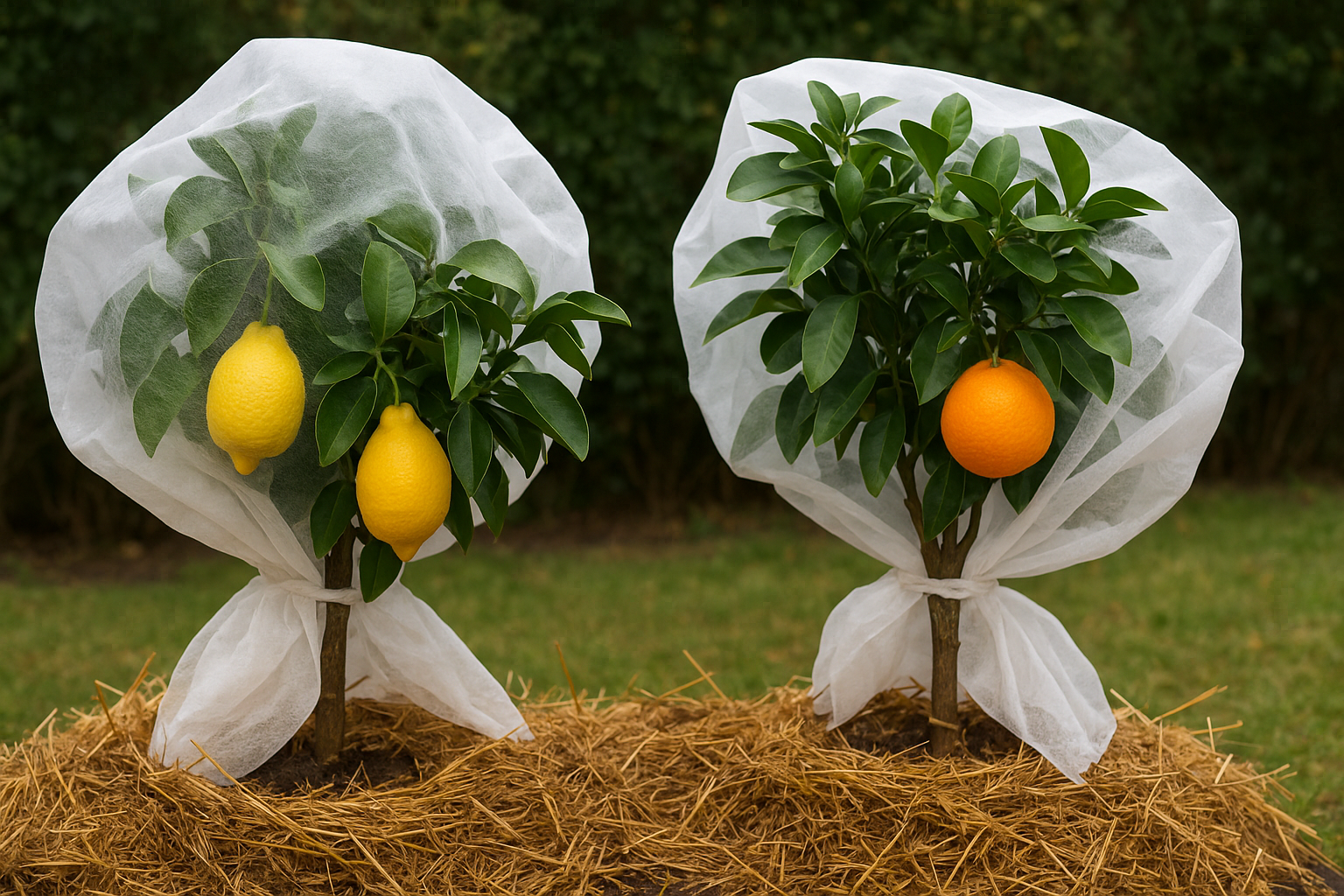
- Frost cloth: wrap loosely, leaving an air pocket. Adds +2 to +4 °C.
- Mulch at the base: wood chips, straw, dead leaves keep roots insulated.
- Windbreak: reed screens, hedges, or panels protect from harsh winds.
Pro tip: double up the frost cloth if a cold snap is forecast.
In Pots: More Flexibility, More Vigilance
Potted citrus are more vulnerable—roots freeze quickly. Two approaches:
- Outdoors, but protected:
- Elevate pots on blocks or bricks.
- Wrap the container in fleece, cardboard, or bubble wrap.
- Add a thick mulch on top.
- Indoors, cool and bright:
- Ideal temperature: 4–10 °C.
- Good spots: unheated greenhouse, cool conservatory, bright garage.
- Not too warm—otherwise the tree keeps growing and exhausts itself.
Conservatory or Living Room
Tempting, but not ideal. Modern heated homes (20 °C + dry air) cause:
- Water stress → yellowing, dropping leaves.
- Scale and mite outbreaks.
- Weak, useless growth.
If it’s your only option, mist often, set a water tray nearby, and monitor pests closely.
Extra Tricks That Make a Difference
Keep a Thermometer
Install a min/max thermometer near your citrus. You’ll know exactly how low temps drop and when to intervene.
Gradual Spring Transition
When frost danger has passed:
- Place pots outside in the sun during the day, bring them in at night.
- Continue for 1–2 weeks.
- Then leave them outside permanently.
This “weaning” avoids thermal shock.
Choose Hardier Varieties
In colder regions, go for hardy citrus: kumquat, yuzu, Meyer lemon. Less stress for you—and them.
Conclusion
Protecting citrus in winter isn’t complicated. Just:
- Know your variety’s hardiness.
- Prepare before the first frost.
- Adapt the method for pots vs. in-ground.
- Avoid overwatering and overheated interiors.
Follow these basics, and your lemon and orange trees will make it through winter looking healthy (or close to it). Come spring, they’ll be ready to flower, perfume your terrace, and reward you with fruit.
Think of overwintering as wrapping your citrus in a cozy blanket with a hot drink: a little effort now for plenty of sweetness later. 🍋🌿