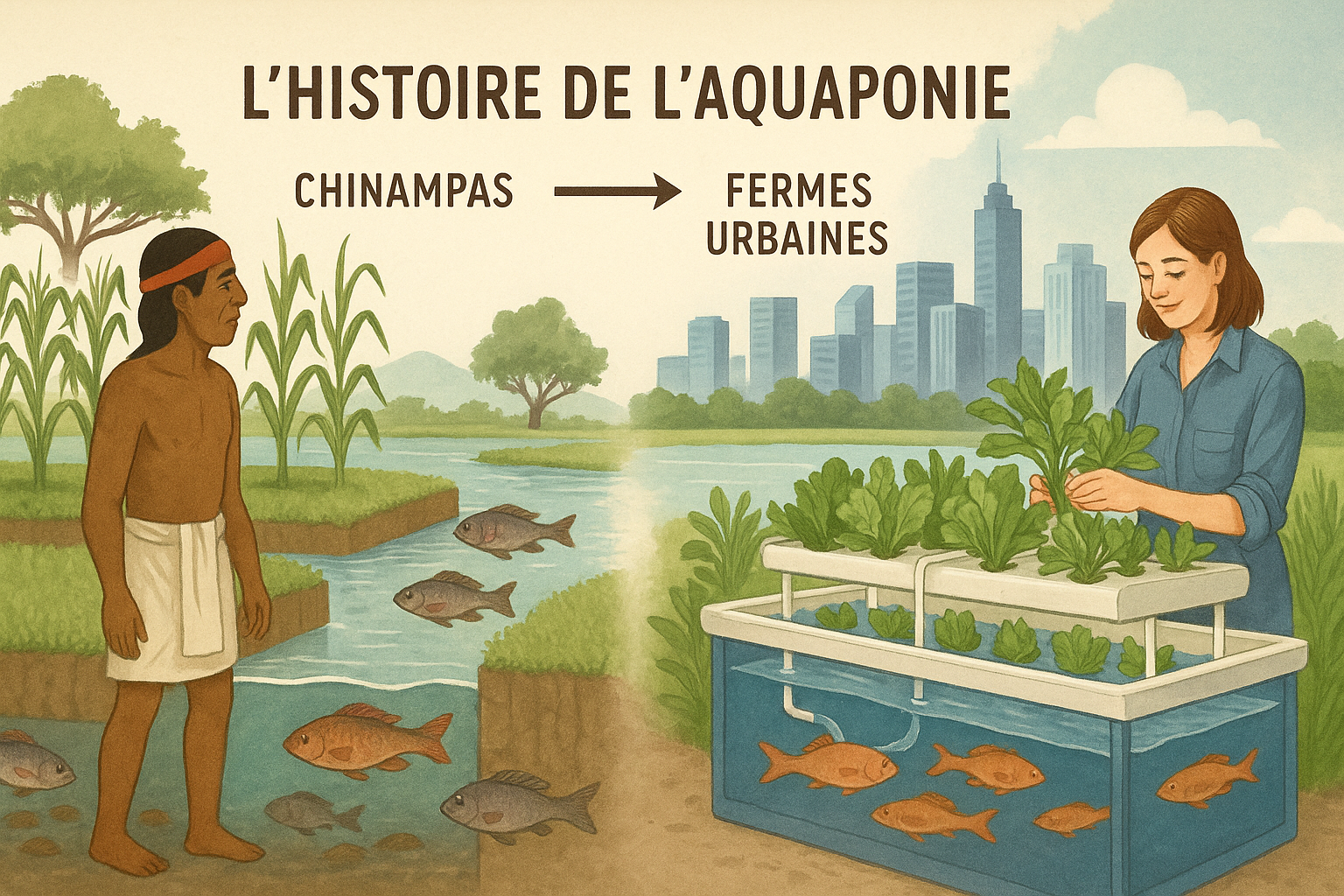
The History of Aquaponics: From the Maya to Modern Urban Farms
When people talk about aquaponics, many imagine a concept straight out of a 21st-century lab. But think again! The idea of making fish and plants work together goes back centuries—even millennia. Our ancestors may not have had the internet, but they already knew how to manage a nitrogen cycle without ever naming it.
Today, aquaponics is making a comeback, dressed up with modern technology, popping up on rooftops, and promoted as a sustainable solution. To understand this trend, let’s take a trip back in time—from the Maya to today’s urban greenhouses.
The Origins of Aquaponics
The Maya and the Chinampas
Picture vast floating gardens surrounded by canals filled with fish and crustaceans. No, it’s not a theme park—it’s the reality of the chinampas, ingeniously built by the Maya and Aztecs.
These “artificial islands” were used to grow maize, vegetables, and flowers while drawing nutrients from the water and aquatic life. No chemical fertilizers needed—nature handled everything. It wasn’t called “aquaponics,” but the principle was already brilliant: recycling natural waste into resources.
Traditional Asian Practices
Meanwhile, on the other side of the world, Asian farmers were cultivating rice in flooded paddies stocked with fish. The fish fertilized the water and kept pests like mosquitoes in check. The result: higher rice yields, fish to eat, and a perfectly balanced system.
It was the ultimate “win-win combo,” centuries ahead of its time.
Other Early Civilizations
It’s very likely that other cultures developed their own variations too. Wherever plants and water met, people seemed to find ways to make nature work in harmony. In many ways, aquaponics is like fire or the wheel—a great idea rediscovered independently by different civilizations.
How the Practice Evolved Over Time
Decline and Forgetfulness in the West
Over time—especially in the West—people turned to chemical fertilizers and vast monocultures. Convenient for mass production, sure, but in the process, we abandoned these clever integrated systems.
Techniques like chinampas faded into obscurity, except in parts of Asia where they survived longer.
Rediscovery and Early Research in the 20th Century
It wasn’t until the 20th century that researchers asked: “What if, instead of throwing away fish waste, we actually used it?” That was a breakthrough. From the 1970s to the 1990s, experiments in the United States, Canada, and Australia revived the concept.
This was when scientists finally gave technical names to what the Maya had known instinctively: the nitrogen cycle and the symbiotic relationship between fish, bacteria, and plants.
The Pioneers of Modern Aquaponics
Institutions such as the University of the Virgin Islands developed reliable, replicable models. Gradually, aquaponics moved from labs into greenhouses, farms, and even the homes of curious hobbyists. Modern pioneers didn’t invent something new—they simply dusted off ancient knowledge and adapted it to our times.
Aquaponics Today and Tomorrow
Urban Farms and Sustainable Projects
Today, aquaponics has left rice paddies and chinampas behind to climb… onto rooftops. In Paris, Montreal, Singapore, and beyond, urban greenhouses are sprouting up where fish and vegetables coexist. City dwellers can eat fresh, pesticide-free tomatoes grown just a few meters from their apartments—using only a fraction of the water.
It’s as if the city itself is turning into one giant garden.
Education and Hobbyist Growth
But aquaponics isn’t just for large farms. More and more schools are setting up small systems to teach kids about water, nutrients, and plant cycles. In backyards and balconies, enthusiasts are building their own DIY setups.
And let’s be honest—there’s real pride in saying: “This tomato? Grown by fish!” 🐟🌱
Looking Ahead: Sustainable Food and Resilient Cities
Tomorrow, aquaponics could play a central role in our cities. Producing food locally, saving up to 90% of water, and reducing transport needs all make it attractive in the face of climate change and population growth.
Imagine apartment buildings with built-in aquaponic farms, or neighborhoods self-sufficient in fresh vegetables. What was once a curiosity could become a standard practice.
Conclusion
Aquaponics isn’t a futuristic invention—it’s a brilliant idea from the past brought back to life. From the Maya and their chinampas to today’s high-tech urban farms, with stops in Asian rice paddies along the way, it shows one clear truth: nature already works in virtuous cycles. All we need to do is pay attention and follow its lead.
Today, aquaponics represents both a return to our roots and a step toward the future. Because sometimes, the best innovations are simply old traditions reinvented.