Understanding Water Balance in Aquaponics: A Practical Guide
In aquaponics, everything revolves around water. It’s the link between your fish (the aquatic roommates), your plants (the hungry freeloaders), and your bacteria (the invisible fairies keeping the system running). But here’s the catch: if the water isn’t balanced, this little household can fall into crisis mode.
A pH out of whack, an ammonia spike, rising nitrites… and your fish are literally gasping. Don’t panic: understanding these parameters is like reading Ikea instructions. At first it seems complicated, but once you see the logic, everything clicks into place.
Why Water Quality Matters in Aquaponics
A Question of Survival for Fish and Plants
In aquaponics, your fish are more than decorative swimmers: they’re living fertilizer machines. Their waste feeds your plants, which in turn filter and purify the water for them. A neat little cycle of cooperation—as long as the water stays in the safe zone.
If it turns toxic, your fish go on strike (or worse), and your plants end up starving. Moral of the story: water balance is the conductor of your mini-ecosystem.
The Basics of the Nitrogen Cycle
Here’s the three-act drama, Netflix-style:
- Fish produce ammonia (their daily contribution—not glamorous, but essential).
- Bacteria transform that ammonia into nitrites (better, but still toxic).
- Other bacteria convert nitrites into nitrates, a plant’s favorite food.
And voilà—your lettuce grows thanks to fish poop. If that’s not circular economy, what is?
Key Parameters to Watch
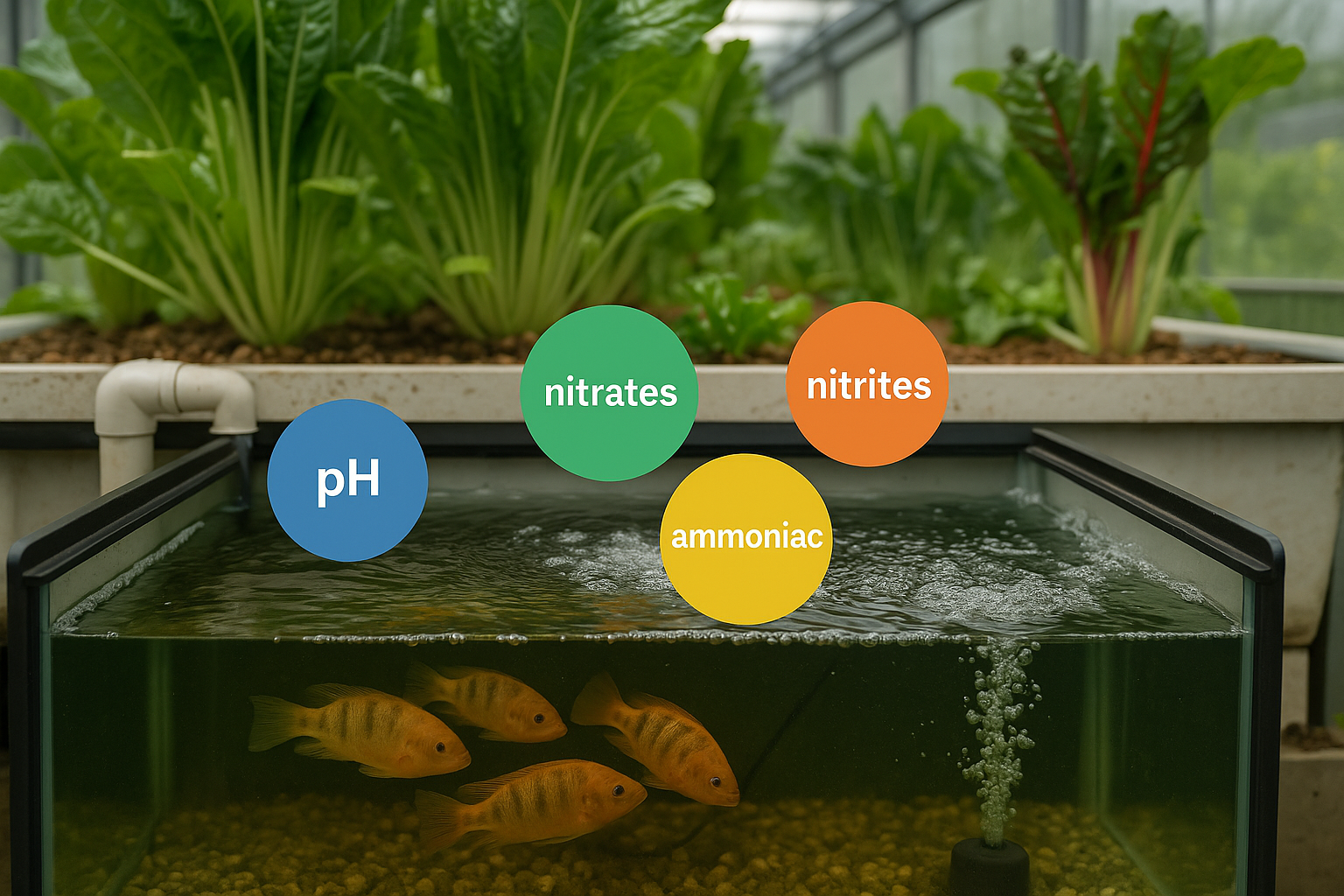
pH and Its Influence
pH is like the overall mood of the household. Too acidic or too alkaline, and someone complains.
- Fish prefer slightly alkaline water (7–8).
- Bacteria work best around 7.
- Plants lean toward slight acidity (6–6.5).
👉 The sweet spot? 6.8–7.2.
Too low, and plants can’t absorb nutrients. Too high, and fish start to suffer. Like any relationship, it’s all about balance.
The Role of Nitrates in Plant Growth
Nitrates are the “good guys” of the cycle. Harmless to fish in low doses, but pure gold for your veggies.
- Too few? Plants wilt.
- Too many? Usually a sign of too many fish or too few plants.
They’re the secret ingredient behind crunchy lettuce and fragrant basil.
Nitrites and Ammonia: The Dangerous Ones
Now for the “villains” of the story:
- Nitrites: above 0.5 mg/L, fish stress and risk disaster.
- Ammonia: public enemy number one. Even in small amounts, it damages fish gills and poisons the system.
If your test kit lights up red here… time for an emergency plan.
Tips for Managing and Correcting Parameters
How to Test Your Water Effectively
You can’t manage what you don’t measure. Water test kits are your best friends. Strips or drops—it doesn’t matter, as long as you use them regularly.
- Weekly for a stable system,
- Daily during startup (yes, like keeping an eye on a newborn).
Daily Best Practices
A few simple rules to avoid panic:
- Don’t overfeed your fish: too much food = ammonia overload.
- Don’t overcrowd the tank: better a few happy fish than a stressed crowd.
- Plant enough: more plants = more nitrate absorption.
- Aerate the water: fish need oxygen—and so do bacteria.
What to Do if Problems Arise (Unstable pH, Nitrite Spike, etc.)
- High pH? Gently lower it with natural solutions (peat, citric acid).
- Low pH? Buffer it with calcium or potassium carbonate.
- Excess nitrites or ammonia? Cut back feeding, change a bit of water, and let bacteria catch up.
In aquaponics, patience is a virtue. The system takes time to stabilize, but once it does, it runs like clockwork.
Conclusion
Water balance is the real superpower of aquaponics. Understanding and monitoring pH, nitrates, nitrites, and ammonia is the key to keeping your fish healthy, your plants productive, and your bacteria thriving.
In short:
- Keep pH between 6.8–7.2.
- Value your nitrates, but avoid excess.
- Watch nitrites and ammonia like a hawk.
- Test often, adjust calmly, and let the system find its rhythm.
At the end of the day, aquaponics is a bit like raising a blended family: fish, plants, and bacteria may be different, but when everyone gets along… life is beautiful.