Watering your vegetable garden properly: when, how much, and how to save water
Watering your vegetable garden properly: when, how much, and how to save water
A vegetable patch without water is like a swimming pool without swimmers: sad and pointless. But hold on—watering doesn’t mean turning your garden into a water park. Smart watering is an art: not too much, not too little, just the right amount at the right time.
The tricky part? Between heatwaves that make you sweat just by opening the door and rain that never shows up (except, of course, on barbecue weekends), it’s hard to know how to handle watering. Should you water every day? Wait until the leaves look droopy? Invest in some high-tech irrigation system worthy of a Bordeaux vineyard?
Don’t worry—we’re going to clear all this up with simple explanations, practical tips, and a splash of humor to keep things as refreshing as a sip of iced lemonade.
Understanding Your Garden’s Thirst
Thirsty crops vs. light drinkers
Not all vegetables drink the same. Some are real camels (garlic, onions, shallots), while others behave like pro athletes, guzzling liters every day.
- Heavy drinkers: tomatoes, cucumbers, zucchini, melons, watermelons—the stars of summer.
- Moderates: carrots, beets, leeks.
- Minimalists: garlic, onions, shallots. You can almost forget them in a corner… almost.
Moral of the story: don’t water everyone the same. It’s like serving the same glass of water to a marathon runner and an office worker—different needs, different rules.
Seasons and weather: your best guides
A tomato plant in August doesn’t need the same care as spring lettuce. Once temperatures hit 30°C (86°F), some veggies can gulp down 10 liters a day. Yes, ten liters. Suddenly, your glass of rosé looks a bit ridiculous.
Use the weather as your compass:
- Mild spring → water every 5–6 days.
- Hot summer → every 2–3 days.
- Heatwave → nearly daily… unless the soil is mulched.
Spotting the signs of thirst
Plants talk. If leaves droop a bit in the evening but perk up by morning, relax. But if they stay floppy the next day—time for water!
Quick test: stick your finger 3 cm into the soil. If it’s dry, grab the watering can.
Watering the Right Way
The best time of day
Watering at noon is like pouring water onto a hot skillet: it evaporates before it helps. The sweet spots are:
- Early morning (before 10 a.m.) → water soaks in before the sun takes over.
- Evening (after 7 p.m. in summer) → useful in extreme heat, but beware of cool nights that encourage disease.
Rule of thumb: water when the sun’s still in bed—or just going down.
Less often, but deeper
Daily sprinkles do more harm than good: roots stay shallow, leaving plants as dependent as teenagers on their phones. Instead, give a deep soak every 3–5 days. Roots dig deeper, plants become tougher, and you save effort.
Aim at the roots, not the leaves
Skip the leaf showers. Wet foliage is a paradise for fungi (blight, mildew…). Water directly at the base. Better yet, create a small basin around the plant so water stays where it’s needed.
Pick your tool wisely
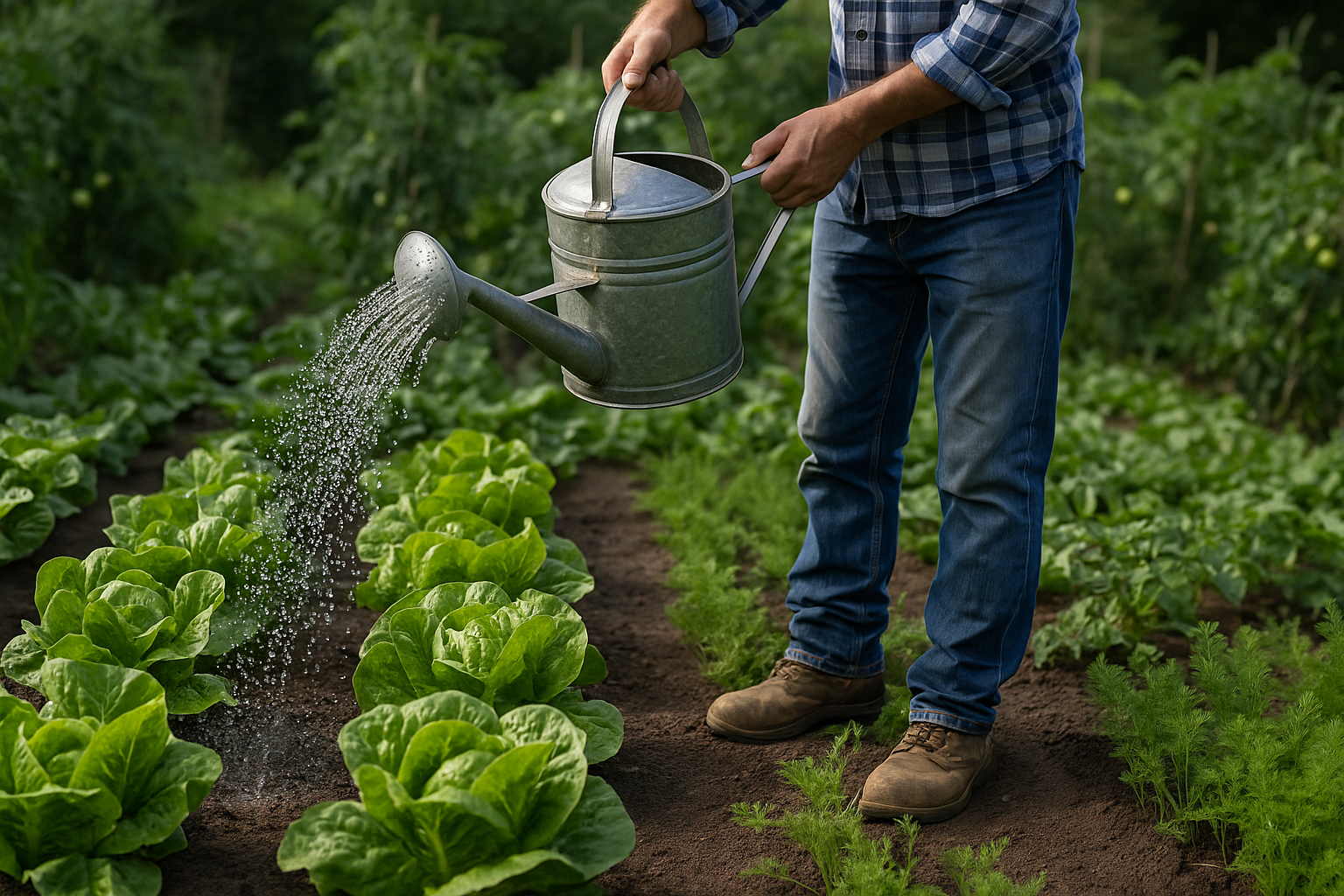
- Watering can: precise, effective, doubles as arm workout.
- Hose: easier, but be careful not to flood the place.
- Drip irrigation or ollas: efficient, eco-friendly, and effortless. Your plants drink while you enjoy your aperitif.
Saving Water Without Sacrificing Harvests
Mulch: your secret weapon
Mulching is like tucking your veggies under a cozy blanket. Straw, dead leaves, shredded wood, dried grass clippings—anything goes. It locks in moisture, halves your watering needs, and keeps weeds in check. Bonus: your garden looks neat.
Collecting rainwater
Why pay for what falls from the sky? A rain barrel under the gutters gives you soft, chlorine-free water—perfect for veggies. And honestly, nothing feels better than watering your tomatoes with “home-brewed” water.
Smart systems: drip, ollas, and soaker hoses
- Drip irrigation → each plant gets just what it needs, right at the roots.
- Ollas (clay pots) → slowly release water underground, saving up to 70%.
- Soaker hoses → steady, gentle watering for long rows.
This is next-gen watering: efficient, discreet, and eco-friendly.
Reusing household water
No, not your laundry rinse water. But cooking water (unsalted), veggie wash water, or the cold run-off while waiting for a hot shower all work. Small habit, big seasonal savings.
Planting low-maintenance crops
Not everything in your garden has to be a water hog. Garlic, onions, shallots, thyme, rosemary, lavender… They thrive with little water. And let’s face it, a garden scented with Mediterranean herbs has style.
Quick Recap: The Golden Rules of Watering
- Water early morning or late evening to limit evaporation.
- Water deeply but less often to strengthen roots.
- Always water at the base, never the leaves.
- Mulch generously → fewer waterings, fewer weeds.
- Collect rainwater → free and eco-friendly.
- Use drip irrigation or ollas for precision and savings.
- Reuse safe household water whenever possible.
Follow these, and your plants will thrive, your water bill will behave, and your eco-conscience will be lighter.
Conclusion
Watering your garden is a bit like raising kids: balance care with independence. Too much water, and plants get lazy. Too little, and they sulk. But with a few simple rules—right timing, right amount, smart water-saving tricks—you’ll have happy, healthy veggies.
And really, what’s more satisfying than biting into a juicy tomato and thinking: “This one thrived because I watered it just right.” Somehow, it tastes even better.