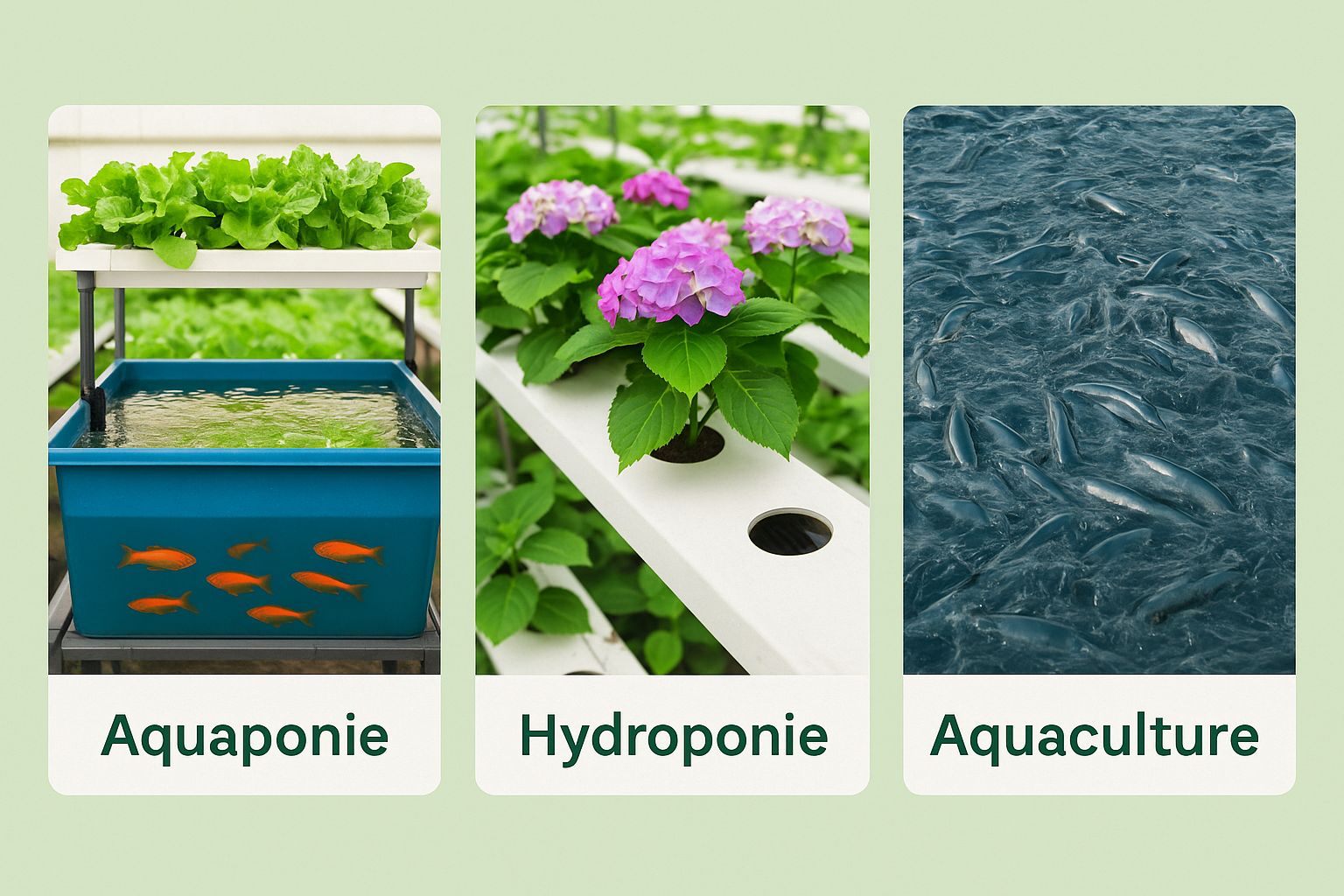
Aquaponics, Hydroponics, Aquaculture: What’s the Difference?
Today, we hear a lot about new ways of producing food. And let’s be honest: the terms aquaponics, hydroponics, and aquaculture sound like they belong in a science-fiction manual. Yet behind these technical words lie three very real practices already in use worldwide.
So, what makes them different? And more importantly, which one suits you best: the curious gardener, the city dweller craving local tomatoes, or the food lover with a taste for fresh fish? Let’s break it down—no unnecessary jargon, promise.
Aquaponics: An Integrated System
The Three Key Players (Fish, Plants, Bacteria)
Aquaponics is the rising star. Picture a shared flat for fish, plants, and bacteria:
- Fish eat, live their lives… and leave a few “gifts” in the water (waste rich in ammonia).
- Bacteria—the invisible little magicians—transform that waste into nutrients.
- Plants happily soak it up and, in return, clean the water for the fish.
The result? A virtuous cycle where everyone benefits. Fish swim in clean water, plants grow like rockets, and you get to harvest both vegetables and fish.
Ecological Benefits
Why is aquaponics so appealing? Because it’s:
- Water-efficient: uses up to 90% less water than traditional gardening,
- Chemical-free: plants are naturally fertilized,
- Doubly productive: fish on one side, vegetables on the other.
It’s the perfect “win-win” model. The catch? It does require an initial investment, and the balance between fish, plants, and bacteria needs monitoring. Even in the best house-shares, a mediator is sometimes needed!
Hydroponics: Growing Without Soil
Substrates and Nutrient Solutions
Think of hydroponics as aquaponics—without the fish. Here, plants grow without soil, their roots either suspended in a nutrient solution or anchored in a medium such as coconut fiber, clay pellets, or rock wool.
The nutrients don’t come naturally—you provide them in carefully measured mineral salts.
Current Applications
Hydroponics is everywhere:
- In high-tech greenhouses, where plant growth is managed like an airplane cockpit,
- In vertical farms, turning skyscrapers into futuristic gardens,
- At home, with DIY kits available for curious hobbyists.
The advantages? Impressive yields and the ability to grow food almost anywhere—even in a garage. The drawbacks? Dependence on fertilizers (often synthetic) and electricity. In short, it’s efficient, but not always the greenest option.
Aquaculture: Farming the Water
Common Species and Methods
Aquaculture has nothing to do with plants. It’s the art of raising aquatic animals: fish, shrimp, mussels, oysters… Whether in ponds, floating cages, or closed systems, it produces animal protein on a large scale.
A few big names:
- Salmon, king of Nordic cuisine,
- Tilapia, a favorite in tropical systems,
- Oysters and mussels, which naturally filter water while delighting our palates.
Environmental Challenges and Innovation
Intensive aquaculture has a mixed reputation: water pollution, overuse of antibiotics, overcrowded tanks… But new solutions are emerging:
- Recirculating Aquaculture Systems (RAS), where water is filtered and reused,
- Integrated Multi-Trophic Aquaculture (IMTA), combining fish, algae, and shellfish to recycle waste.
Why the push for innovation? Because aquaculture already supplies nearly 50% of the world’s fish consumption.
Conclusion
Aquaponics, hydroponics, aquaculture: three similar-sounding words, but three very different realities.
- Aquaponics: the eco-friendly “flat share” of fish + plants + bacteria—a natural balance at its best.
- Hydroponics: the futuristic garden, soil-free and fish-free, with total control over nutrition.
- Aquaculture: aquatic farming, essential to feeding much of the planet.
Which one’s for you?
- Want a self-sufficient, sustainable mini-farm? Go aquaponics.
- Dreaming of record-breaking vegetable yields? Hydroponics.
- More of a grilled fish lover? Aquaculture.
And if you can’t choose, don’t worry—even scientists are blending these practices today. In farming, as in cooking, the best results often come from smart combinations.